


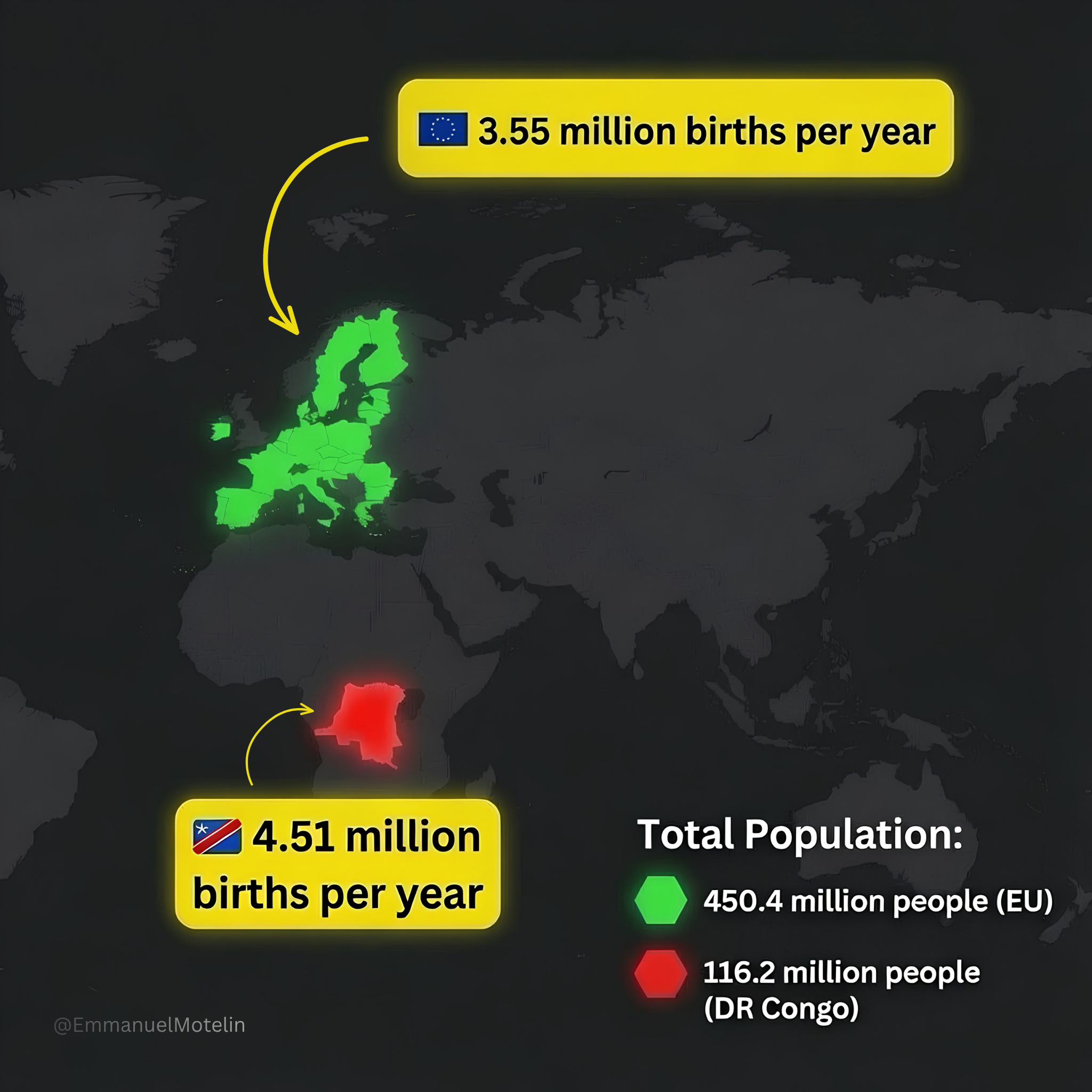
The European Union, despite comprising a substantial population, registers approximately 3.55 million births across its 27 member states, a figure surpassed by the Democratic Republic of the Congo’s 4.51 million live births, the second-highest in Africa. Nigeria leads the African continent with around 7.5 million live births. However don’t let those high birth numbers fool you just yet.
However, looking at volume alone obscures a vital reality: (survival penalty) In parts of sub-Saharan Africa, high birth counts are tempered by higher mortality rates, particularly regarding under-five mortality and lower average life expectancy. These high birth numbers do not translate one-to-one into long-term adult population growth, as limited access to healthcare keeps demographic survival efficiency lower than in the West… well…at least for now.
It is crucial to note, however, that this is a rapidly evolving landscape; many nations, such as Kenya and South Africa, have already made significant strides in improving their healthcare systems as of 2026, which is beginning to narrow that survival gap.
The European Union faces its own Catch-22. While Africa navigates the complexities of mortality and healthcare scaling, Europe is staring down a sudden population collapse risk that Africa does not currently have to worry about. Its average fertility rate of 1.34 is far below the 2.1 replacement rate necessary for stability.
This is a structural, permanent contraction rather than a struggle with survival. Because Europe’s population is already aging, the region is facing negative momentum… there are simply too few young people entering their reproductive and working years to sustain the current system.
While Africa works to improve the survival outcomes of its massive youth population, the EU faces the cold reality of a top-heavy demographic pyramid that no longer replaces itself. Both scenarios represent the defining demographic hurdles of the 21st century


+ There are no comments
Add yours