


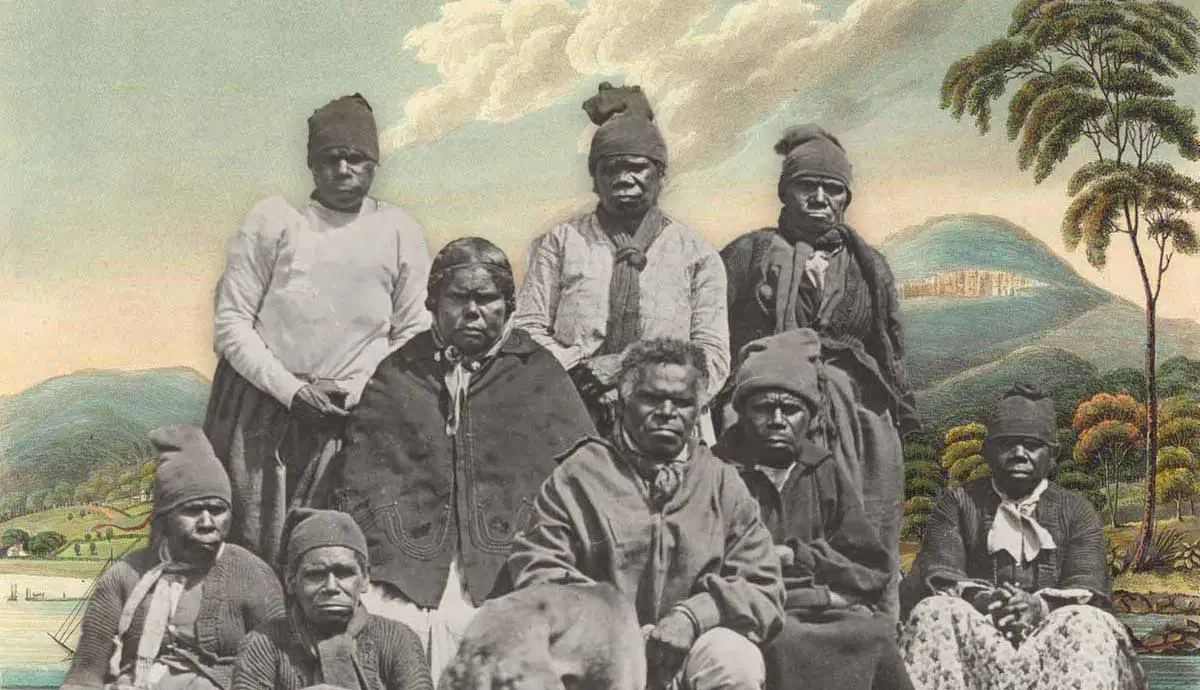
Did you know Australia was never white prior to European contact? The Tasmanian Aboriginal people, whose ancestors arrived on the island approximately 35,000 years ago, thrived in isolation for millennia after rising sea levels severed their connection to mainland Australia around 6000 BC.
Archaeological evidence suggests a population of 3,000 to 15,000 before European contact, with a sophisticated society deeply tied to the land. Their oral traditions, as recorded by early British observers, spoke of spiritual entities inhabiting the island’s valleys and caves, reflecting a profound connection to their environment. A striking 19th-century photograph by John William Beattie captures this heritage, showing a group of Aboriginal individuals adorned in traditional attire, accompanied by a dingo, a resilience to their enduring way of life before colonial disruption.
The Arrival of Europeans and the Descent into Violence
The first European contact came in 1642 when Dutch navigator Abel Tasman explored the island, naming it Van Diemen’s Land after the governor-general of the Dutch East India Company, Anthony van Diemen.

However, it was the British arrival in 1777 that marked the beginning of a tragic chapter. By 1803, the British established a penal colony, bringing convicts and settlers whose expansionist ambitions clashed with Aboriginal land rights. Initial interactions were marred by disease introduced by European sailors, which likely weakened Aboriginal immunity, setting the stage for further devastation.
The conflict escalated into what became known as the “Black War” (1803-1830), a 27-year period of guerrilla warfare. British settlers and convicts, influenced by racial ideologies that deemed Aboriginal people subhuman, engaged in systematic killings and displacement. Historical accounts, including those from historian Jeremy Paxman, argue that this constituted genocide, a view supported by the drastic population decline from an estimated 7,000-8,000 in 1803 to fewer than 75 by 1830. The 1804 Risdon Cove massacre, where British soldiers killed numerous Aboriginal people, exemplifies the violence, with a surviving boy named Robert Hobart May becoming a poignant symbol of early Indigenous-British contact.
The Black War and Its Aftermath
The “Black War” saw both sides commit atrocities, with Aboriginal resistance met by brutal reprisals. The British employed tactics such as the “Black Line,” a military operation to drive Aboriginal people from their lands, and even considered extreme measures like poisoning food supplies or using bloodhounds.

By 1833, George Augustus Robinson, under the sponsorship of Lieutenant-Governor George Arthur, persuaded the remaining 200 survivors to surrender with promises of protection, promises largely unfulfilled as their lands were never returned.
Historians like Lyndall Ryan suggest these massacres were part of an organized process sanctioned by colonial authorities, while others, such as Henry Reynolds, note the settlers’ calls for “extermination” reflected a genocidal intent. The debate persists: was this a deliberate genocide akin to later atrocities, or a violent response to perceived threats? Regardless, the outcome was near annihilation, with the Aboriginal population reduced to a mixed-race community in the Bass Strait, where their descendants live today.
The photograph from the @AfricanArchives X post, shared on July 5, 2023, serves as a haunting reminder of this lost heritage. The image, paired with the thread’s narrative, underscores a history of kidnapping, enslavement, torture, and murder that the British inflicted on the Tasmanian Aborigines.
This history, as the thread suggests, should disturb, upset, and enrage us—emotions that studying history often evokes when it reveals uncomfortable truths.


+ There are no comments
Add yours